Introduction to Bitcoin Knots
Bitcoin Knots is an enhanced derivative of Bitcoin Core, the reference implementation of the Bitcoin protocol. Created by Luke Dashjr in 2011 and maintained by him with community contributors, Bitcoin Knots includes a collection of patches that add features, improve functionality, and provide additional configuration options not available in Bitcoin Core.
History
Bitcoin Knots was originally known as "Bitcoin LJR" when it emerged in 2011. Luke Dashjr, one of the earliest and most active contributors to Bitcoin Core (involved since 2010), created Knots to include modifications and improvements that hadn't been merged into Core.
The name "Knots" has a dual meaning — it both references the merging/tying together of code branches and pays homage to a biblical passage significant to Dashjr's Roman Catholic faith.
Key milestones:
- 2011: Project launched as Bitcoin LJR
- 2023: Addressed the "Inscriptions" exploit (CVE-2023-50428)
- 2023: Luke Dashjr co-founded Ocean mining pool (which runs Knots)
- 2025: Adoption surged 638% as debates over OP_RETURN limits intensified
- November 2025: Release v29.2.knots20251110
- May 2026: Current release v29.3.knots20260508 — the first release to ship the BIP-110/RDTS soft fork (confirmation required; a non-RDTS build is also published)
As of mid-2026, Bitcoin Knots powers roughly 23% of all reachable Bitcoin nodes (after peaking near 25% in late 2025) — a significant share of the network's infrastructure.
What Makes Knots Different?
Bitcoin Knots follows the same consensus rules as Bitcoin Core — your node will validate blocks identically. The differences are in:
- Policy Options: Fine-grained control over what transactions your node relays and mines
- Wallet Features: Extended wallet functionality including maintained legacy wallet support
- User Interface: GUI improvements like dark mode and network monitoring
- RPC Commands: Additional commands for power users and developers
- Privacy: Built-in Tor integration and enhanced privacy options
- Conservative Defaults: Knots defaults to filtering certain transaction types that Core allows
Bitcoin Knots follows identical consensus rules to Bitcoin Core. Running Knots does not affect your node's ability to validate the blockchain correctly. The one exception is the BIP-110/RDTS soft fork introduced in v29.3: the standard build will enforce it on its activation schedule (~September 2026) after asking for your confirmation, and a non-enforcing build is also published — see BIP-110 / RDTS Integration. Otherwise the differences are purely in local policy and features.
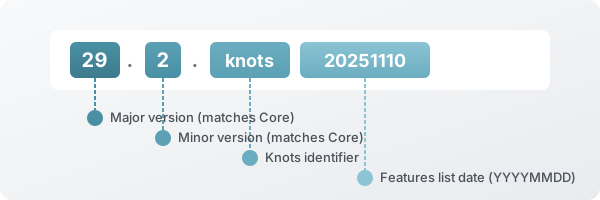
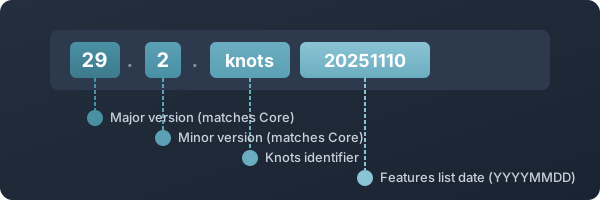
Version Numbering
Bitcoin Knots versions track Bitcoin Core releases with an additional identifier:
Who Is This For?
Everyone — now that Bitcoin Core has removed important safeguards (OP_RETURN limits, legacy wallet support), Bitcoin Knots represents a return to sensible defaults for all users.
Whether you're a:
- Node operator wanting more control over relay policies
- Miner needing additional block template options
- Privacy-focused user wanting built-in Tor support
- Developer needing extended RPC functionality
- Long-term holder preferring maintained legacy wallet support
- Anyone who believes Bitcoin should remain focused on monetary transactions
Bitcoin Knots provides the features and policy controls that Core has abandoned.
Philosophy
Bitcoin Knots takes a more conservative approach than Bitcoin Core regarding blockchain usage. Key philosophical differences:
- Filtering Non-Monetary Use: Knots provides options to filter various non-monetary uses of Bitcoin that Dashjr views as spam
- Preserving Bitcoin's Purpose: Focus on Bitcoin as decentralized digital money, not a general data storage layer
- User Choice: Provides configuration options so users can decide their own policies
- Feature Inclusion: Includes useful features that Core hasn't prioritized or has removed
The philosophical differences between Knots and Core came to a head in 2025 with Bitcoin Core v30's controversial removal of OP_RETURN limits. Nick Szabo, Jimmy Song, and Luke Dashjr were among the prominent voices opposing the change. The fight has since moved to the BIP-110/RDTS soft fork, which ships in Knots 29.3. Read the full story →
Notable Features
| Feature | Description |
|---|---|
-rejectparasites | Filter CAT21 spam transactions (on by default) |
-datacarriersize | Configurable OP_RETURN limit (83 bytes default) |
-corepolicy | Single flag to use Bitcoin Core defaults instead |
-consensusrules | Confirmation setting for the BIP-110/RDTS soft fork (new in v29.3) |
| Legacy Wallet | Maintained support (removed in Core 30) |
| Embedded Tor | Built-in Tor subprocess management |
| Dark Mode | GUI dark theme support |
| Software Expiry | Warnings to keep your node updated |
Getting Help
- Official Website: bitcoinknots.org
- GitHub Issues: github.com/bitcoinknots/bitcoin/issues
- Source Code: github.com/bitcoinknots/bitcoin
Next Steps
- Installation Guide — Download and install Bitcoin Knots
- Quick Start — Get your node running in minutes
- Differences from Core — Detailed comparison