Transaction Filtering
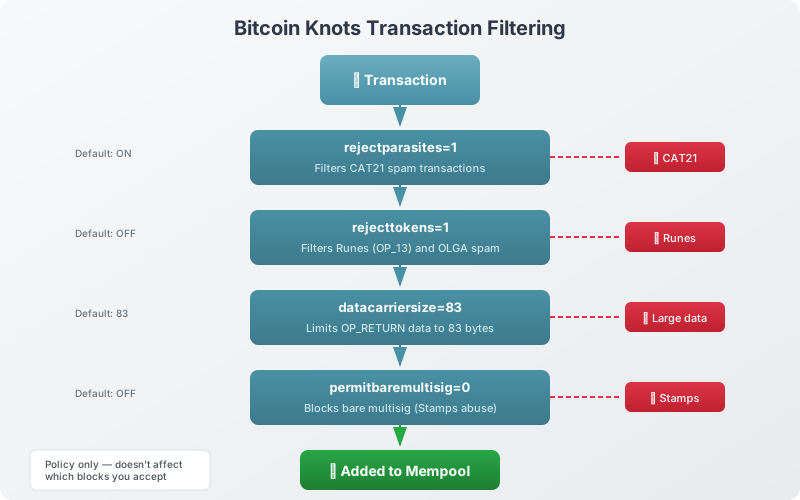
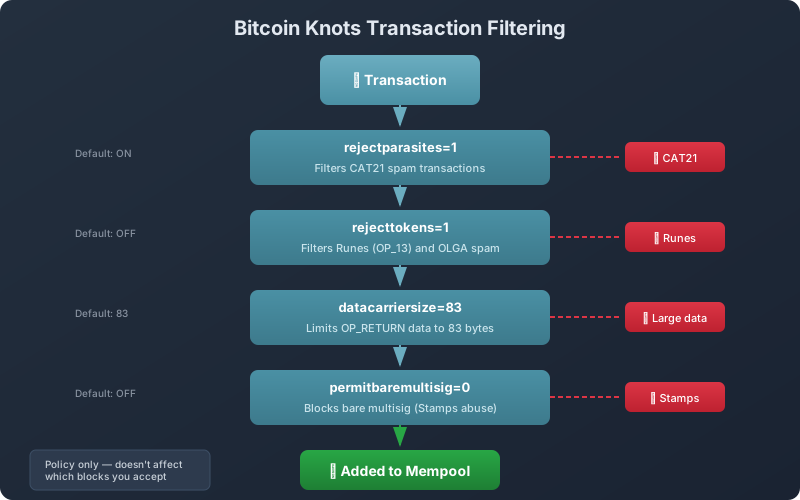
Bitcoin Knots provides comprehensive tools to filter transactions you consider spam from your mempool. This is one of the most significant differences from Bitcoin Core and a primary reason for Knots' 850% adoption surge in 2024-2025.
Why Filter Transactions?
The Problem
Since late 2022, several protocols have emerged that embed non-financial data into Bitcoin transactions:
| Protocol | Data Location | UTXO Impact | Prunable? |
|---|---|---|---|
| Ordinals/Inscriptions | Witness data (OP_FALSE OP_IF) | Minimal | Yes |
| BRC-20 Tokens | Inscriptions (JSON) | Minimal | Yes |
| Runes | OP_RETURN | None | Yes |
| Stamps | Bare multisig outputs | Severe | No |
These protocols have caused:
- Mempool congestion during high-activity periods
- Fee spikes that price out small transactions
- UTXO set bloat (80M → 160M+ UTXOs in 2023)
- Increased node resource requirements
The Philosophy
Bitcoin Knots gives node operators choice:
"Bitcoin works with the assumption that a majority of miners are honest, not malicious. Besides, spam-filtered blocks often have more fees anyway for some reason." — Luke Dashjr
You decide what your node relays. These are policy rules, not consensus rules — your node still accepts all valid blocks regardless of your filter settings.
How Each Protocol Works
Understanding how these protocols work helps you understand what the filters target.
Ordinals & Inscriptions
Ordinals assign a serial number to each satoshi based on mining order. Inscriptions attach data to these satoshis using a clever trick that bypasses the traditional datacarriersize limit:
OP_FALSE
OP_IF
  OP_PUSH "ord"
  OP_PUSH 1              # content-type tag
  OP_PUSH "image/png"    # MIME type
  OP_PUSH 0              # content tag
  OP_PUSH [image data]   # actual content
  OP_PUSH [more data]    # split into 520-byte chunks
OP_ENDIF
Why this bypasses limits:
- Traditional
datacarriersizeonly applied to OP_RETURN - The
OP_FALSE OP_IF ... OP_ENDIFenvelope is technically valid script that never executes - Data is stored in the witness field, which gets a 75% fee discount (SegWit)
- This was filed as CVE-2023-50428 by Luke Dashjr
BRC-20 Tokens
BRC-20 tokens embed JSON in inscriptions:
{"p":"brc-20","op":"deploy","tick":"ordi","max":"21000000","lim":"1000"}
{"p":"brc-20","op":"mint","tick":"ordi","amt":"1000"}
{"p":"brc-20","op":"transfer","tick":"ordi","amt":"100"}
The token rules aren't enforced by Bitcoin — off-chain indexers interpret the JSON and track balances. The inscriptions just store the data.
Runes
Runes use OP_RETURN more efficiently than BRC-20:
OP_RETURN
OP_13              # Rune protocol identifier
[encoded data]     # Rune ID, amounts, outputs
Runestones (valid Runes messages) define token operations. Cenotaphs (malformed runestones) cause tokens to be burned.
Advantage over inscriptions: OP_RETURN outputs are provably unspendable, so they don't bloat the UTXO set.
Stamps (Most Harmful)
Bitcoin Stamps are the most problematic because they abuse bare multisig outputs:
OP_1 [pubkey1] [pubkey2] [pubkey3] OP_3 OP_CHECKMULTISIG
The "public keys" are actually encoded image data. These outputs:
- Look spendable to nodes (but aren't — the "keys" are fake)
- Must be stored in the UTXO set forever
- Cannot be pruned by pruned nodes
- Increase every node's memory and storage requirements
This is why permitbaremultisig=0 is particularly important.
Configuration Options
Quick Reference
| Option | Default (Knots) | Effect |
|---|---|---|
rejectparasites | 1 (on) | Filters CAT21 spam |
rejecttokens | 0 (off) | Filters Runes |
datacarriersize | 83 | Max OP_RETURN bytes |
datacarriercost | 1 | Vbytes counted per data byte (1 = full cost, no witness discount) |
datacarrierfullcount | 1 (on) | Apply datacarriersize limit to all known datacarrier methods |
maxscriptsize | 1650 | Max script size (incl. witness stack) |
permitbaremultisig | 0 (off) | Blocks Stamps |
acceptnonstddatacarrier | 0 (off) | Strict OP_RETURN format |
corepolicy | 0 (off) | Use Core defaults instead |
- Datacarrier matching was updated to catch a newer bypass variation, and 'opnet' data is now recognized.
- New
subdustfeepenaltyoption (default on): sub-dust outputs reduce a transaction's effective fee by the shortfall, so dust-creating transactions need higher fees. See Dust and Fees.
Detailed Options
rejectparasites
Filters CAT21 spam transactions. Enabled by default in Knots.
# Default in Knots - filters CAT21 spam
rejectparasites=1

# Disable filtering
rejectparasites=0
Note: This option specifically targets CAT-21 spam (transactions with nLockTime set to 21), not inscriptions or ordinals in general. Inscription-envelope data is instead limited via datacarrierfullcount + datacarriersize (see below).
rejecttokens
Filters Runes protocol transactions.
# Filter Runes
rejecttokens=1
Detects OP_RETURN outputs starting with OP_13 (the Runes identifier). Updated in v29.1 to also detect "OLGA" spam variants.
datacarriersize
Maximum size of data in OP_RETURN outputs.
# Knots default (80 bytes of data + overhead)
datacarriersize=83

# Stricter (42 bytes - enough for hashes; the traditional Knots value)
datacarriersize=42

# Disable all OP_RETURN relay
datacarriersize=0
Why 83? 1 byte OP_RETURN + 2 bytes pushdata opcodes + 80 bytes data = 83 bytes.
Luke Dashjr's recommendation for filtering Runes: set datacarriersize=0 in bitcoin.conf. Source
datacarriercost
Treats extra data in transactions as at least N vbytes per actual byte, adjusting the "virtual size" used for fee calculation.
# Knots default - each data byte counts as 1 full vbyte
# (i.e. no witness discount for data)
datacarriercost=1

# Core-equivalent witness discount (what corepolicy=1 sets)
datacarriercost=0.25

# 4x penalty beyond full cost - data-heavy transactions
# need much higher fees
datacarriercost=4
Higher values mean data-heavy transactions need higher fees to enter your mempool. The default of 1 already counts data at full cost; values above 1 are an extra penalty.
datacarrierfullcount
Applies the datacarriersize limit to all known datacarrier methods (not just OP_RETURN), making it the central anti-bypass knob. Enabled by default in Knots.
# Default in Knots - count data in inscription envelopes,
# fake pubkeys, etc. against the datacarriersize limit
datacarrierfullcount=1

# Only apply the limit to OP_RETURN (Core-style; corepolicy=1 sets this)
datacarrierfullcount=0
This is what makes datacarriersize effective against inscriptions and similar bypass techniques that store data outside OP_RETURN.
maxscriptsize
Limits the size of scripts your node relays and mines. Default: 1650 bytes — setting a larger value loosens the policy rather than tightening it.
# Knots default - already restrictive
maxscriptsize=1650

# Stricter still
maxscriptsize=1000
In v29.1+, this applies to the entire witness stack of each input, closing evasion attempts.
permitbaremultisig
Controls relay of bare multisig outputs. Disabled by default in Knots.
# Default in Knots - blocks Stamps
permitbaremultisig=0

# Allow bare multisig (Core behavior)
permitbaremultisig=1
This is critical for preventing UTXO bloat from Stamps.
acceptnonstddatacarrier
Controls whether non-standard OP_RETURN formats are accepted.
# Default in Knots - strict format only
acceptnonstddatacarrier=0

# Allow any OP_RETURN format
acceptnonstddatacarrier=1
corepolicy
Revert to Bitcoin Core's default policies (disabling Knots filtering).
# Use Core-compatible policies (no filtering)
corepolicy=1
Useful for testing or if you want Knots features but Core relay behavior.
Recommended Configurations
Maximum Filtering (Ocean-style)
Used by Ocean mining pool:
# CAT-21 spam (default in Knots)
rejectparasites=1

# Runes and tokens
rejecttokens=1

# Minimal OP_RETURN (or 0 to disable)
datacarriersize=42

# Apply the size limit to all datacarrier methods,
# including inscription envelopes (default in Knots)
datacarrierfullcount=1

# 4x fee penalty for data bytes
datacarriercost=4

# Block Stamps
permitbaremultisig=0

# Strict OP_RETURN format
acceptnonstddatacarrier=0
Moderate Filtering (Knots Default)
Default Knots behavior:
# These are default in Knots - shown for clarity
rejectparasites=1
permitbaremultisig=0
acceptnonstddatacarrier=0
datacarriersize=83
No Filtering (Core-compatible)
If you want Knots features but Core relay policy:
corepolicy=1
Or explicitly:
rejectparasites=0
rejecttokens=0
permitbaremultisig=1
acceptnonstddatacarrier=1
datacarriersize=100000
How Detection Works
Pattern Matching
Knots examines transaction structure for known patterns:
Inscriptions:
Witness contains: OP_FALSE OP_IF "ord" ... OP_ENDIF
Runes:
Output script: OP_RETURN OP_13 [data]
Stamps:
Output script: OP_n [pubkey...] OP_m OP_CHECKMULTISIG
(where pubkeys don't correspond to valid points)
Limitations
Filtering is based on pattern matching, not perfect detection. Determined actors can:
- Modify envelope formats slightly
- Use novel encoding schemes
- Pay higher fees to get into blocks directly
These are policy tools, not consensus rules. They reduce spam propagation but cannot prevent it entirely.
Monitoring Filtered Transactions
Check Filter Status
# See current mempool policies
bitcoin-cli getmempoolinfo

# Check specific policy settings (if exposed via RPC)
bitcoin-cli logging '["mempool"]'
Watch Debug Log
# Monitor rejections in real-time
tail -f ~/.bitcoin/debug.log | grep -iE "reject|filter|policy"

# Count rejections
grep -c "rejected" ~/.bitcoin/debug.log
Test Transaction Acceptance
# Test if a transaction would be accepted
bitcoin-cli testmempoolaccept '["<raw_transaction_hex>"]'
Impact on Mining
If you mine (solo or pool), your filtering affects block templates:
# Get block template (filtered based on your policy)
bitcoin-cli getblocktemplate '{"rules":["segwit"]}'
Revenue considerations:
- Filtered transactions = potentially missed fees
- However, Dashjr notes "spam-filtered blocks often have more fees anyway"
- Ocean pool runs filtered and reports competitive revenue
Per-Template Overrides (Knots-only)
Knots' getblocktemplate accepts a minfeerate option: only include transactions paying at least this many sats/vbyte (defaults to the -blockmintxfee setting; using it disables the template cache):
# Only include transactions paying at least 10 sats/vbyte
bitcoin-cli getblocktemplate '{
  "rules": ["segwit"],
  "minfeerate": 10
}'
The Filtering Debate
Arguments For Filtering
- Resource protection — Reduces mempool churn and bandwidth
- UTXO set health — Especially important for Stamps
- Network sustainability — Prevents unbounded growth
- User choice — Node operators decide their policy
- Historical precedent — Spam filtering has existed since 2013
Arguments Against Filtering
- Revenue — May miss some fee-paying transactions
- Censorship concerns — Who defines "spam"?
- Effectiveness — Miners ultimately include what they want
- Cat and mouse — Spammers adapt to filters
The Reality
- Filtering is your node's policy — you're not preventing others from mining transactions
- Even without filtering, you can't prevent data on Bitcoin
- These are relay policies, not consensus changes
- Most pools don't filter, so filtered transactions still get mined
GUI Configuration
Bitcoin Knots includes GUI options for filtering (unlike Core):
- Settings → Options → Network tab
- Look for policy options
- Set datacarriersize, permitbaremultisig, etc.
The GUI exposes what would otherwise require editing bitcoin.conf.
Verifying Your Configuration
After setting options, verify they're active:
# Restart bitcoind to apply changes
bitcoin-cli stop
bitcoind -daemon

# Check that node started with your settings
grep -E "datacarrier|permit|reject" ~/.bitcoin/debug.log | tail -20
See Also
- OP_RETURN Controversy — The Core v30 debate
- Mempool Policies — All policy options
- Dust and Fees — Fee-related filtering
- Mining Guide — Block template configuration
- CVE-2023-50428 — The inscription bypass issue